Yale University Press
Body, Memory, and Architecture
Regular price
$47.95 USD
Regular price
Sale price
$47.95 USD
Unit price
per
Shipping calculated at checkout.
Couldn't load pickup availability
Title: Body, Memory, and Architecture
Author: Kent C Bloomer
ISBN: 9780300021424
Publisher: Yale University Press
Published: 1977
Binding: Paperback
Language: English
Edition: First Edition
Number of Pages: 159
Condition Note: Clean, unmarked copy with some edge wear. Good binding. Dust jacket included if issued with one. We ship in recyclable American-made mailers. 100% money-back guarantee on all orders.
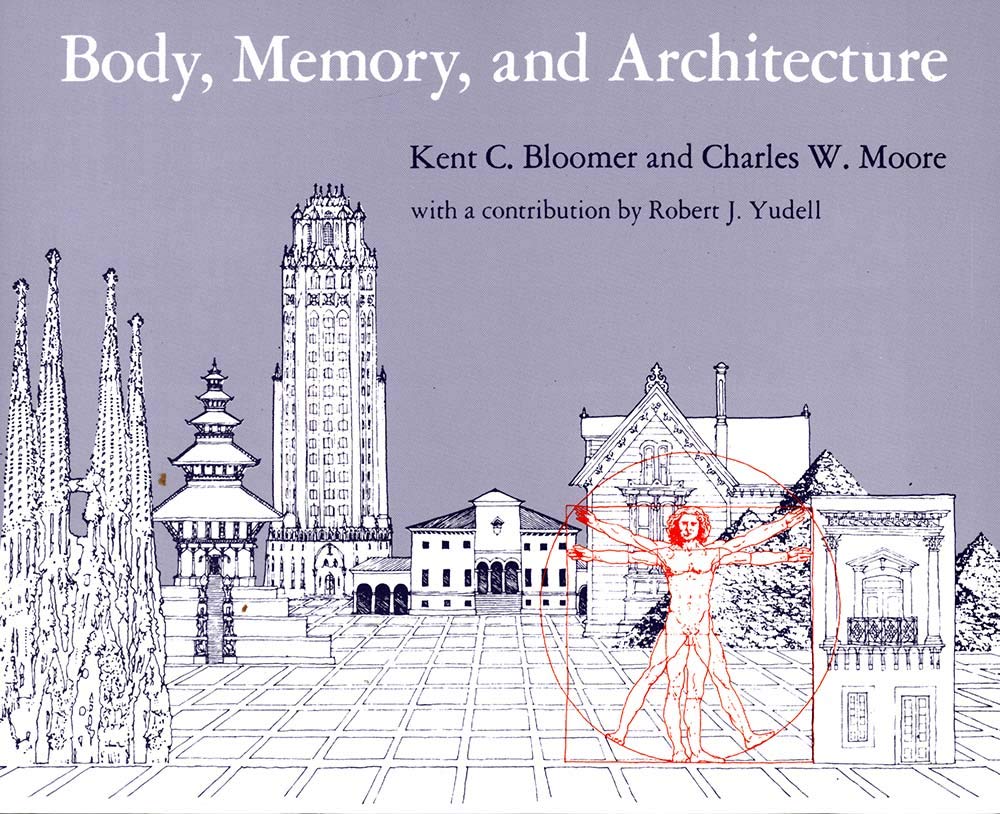
Publisher Description: "A valuable contribution."--Paul Goldberger, New York Times "Nearly every page of the book is wittily illustrated with cartoons, drawings, and photographs. If the coming generation or architects--and their clients--pay attention to it, America may someday be a much more agreeable place."--John Fischer, Harpers As teachers of architectural design, Kent Bloomer and Charles Moore have attempted to introduce architecture from the standpoint of how buildings are experienced, how the affect individuals and communities emotionally and provide us with a sense of joy, identity, and place. In giving priority to these issues and in questioning the professional reliance on abstract two-dimensional drawings, they often find themselves in conflict with a general and undebated assumption that architecture is a highly specialized system with a set of prescribed technical goals, rather than a sensual social art historically derived from experiences and memories of the human body. This book, an outgrowth of their joint teaching efforts, places the human body at the center of our understanding of architectural form. Body, Memory, and Architecture traces the significance of the body from its place as the divine organizing principle in the earliest built forms to its near elimination from architectural thought in this century. The authors draw on contemporary models of spatial perception as well as on body-image theory in arguing for a return of the body to its proper place in the architectural equation.
Author: Kent C Bloomer
ISBN: 9780300021424
Publisher: Yale University Press
Published: 1977
Binding: Paperback
Language: English
Edition: First Edition
Number of Pages: 159
Condition Note: Clean, unmarked copy with some edge wear. Good binding. Dust jacket included if issued with one. We ship in recyclable American-made mailers. 100% money-back guarantee on all orders.
Publisher Description: "A valuable contribution."--Paul Goldberger, New York Times "Nearly every page of the book is wittily illustrated with cartoons, drawings, and photographs. If the coming generation or architects--and their clients--pay attention to it, America may someday be a much more agreeable place."--John Fischer, Harpers As teachers of architectural design, Kent Bloomer and Charles Moore have attempted to introduce architecture from the standpoint of how buildings are experienced, how the affect individuals and communities emotionally and provide us with a sense of joy, identity, and place. In giving priority to these issues and in questioning the professional reliance on abstract two-dimensional drawings, they often find themselves in conflict with a general and undebated assumption that architecture is a highly specialized system with a set of prescribed technical goals, rather than a sensual social art historically derived from experiences and memories of the human body. This book, an outgrowth of their joint teaching efforts, places the human body at the center of our understanding of architectural form. Body, Memory, and Architecture traces the significance of the body from its place as the divine organizing principle in the earliest built forms to its near elimination from architectural thought in this century. The authors draw on contemporary models of spatial perception as well as on body-image theory in arguing for a return of the body to its proper place in the architectural equation.