Princeton University Press
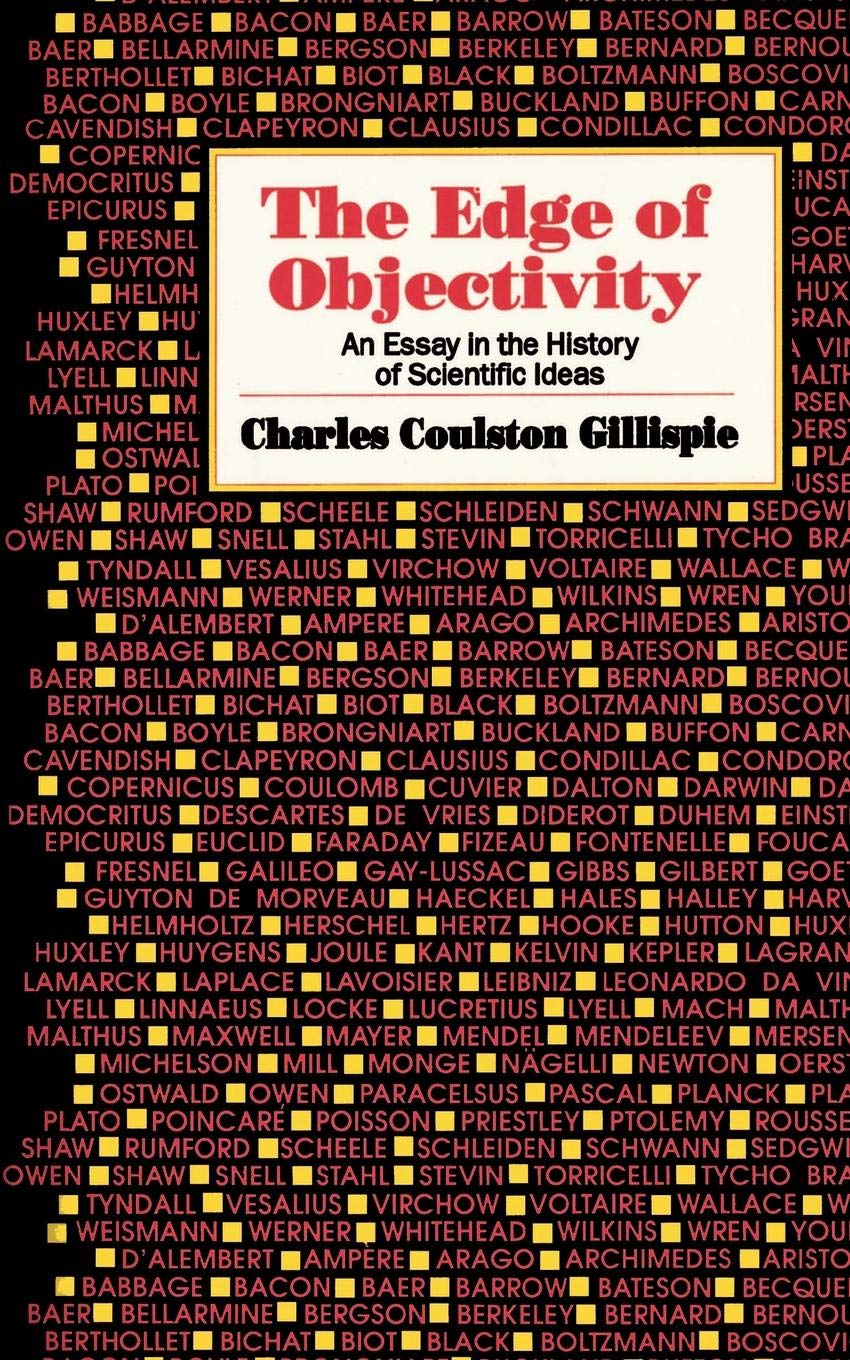
Edge of Objectivity: An Essay in the History of Scientific Ideas
Regular price
$12.95 USD
Regular price
Sale price
$12.95 USD
Unit price
per
Shipping calculated at checkout.
Couldn't load pickup availability
Title: Edge of Objectivity: An Essay in the History of Scientific Ideas
Author: Charles Coulston Gillispie
ISBN: 0691023506
Publisher: Princeton University Press
Published: 1966
Binding: Paperback
Language: English
Edition: 3rd Printing
Number of Pages: 576
Condition Note: Clean, unmarked copy with some edge wear. Good binding. Dust jacket included if issued with one. We ship in recyclable American-made mailers. 100% money-back guarantee on all orders.
Publisher Description: From Galileo's analysis of motion to the theories of evolution and relativity, Charles Gillispie takes us on a masterly tour of the world of scientific ideas. The history of modern science is portrayed here as the development of objectivity through the study of nature."Gillispie has written a bold, penetrating, and very personal book. . . . Deft evocation of personality, bright flashes of biographical detail, and enough connected narrative to show the direction and complexity of scientific advance, are all subordinated to the task of examining the crucial attitudes and ideas, the signal commitments of thought, which have shaped modern science and troubled the mind of modern man. . . . All told, this is an exciting book, based on wide and often deep scholarship, a pleasure to read and to meditate upon. It is sure to be widely read, often quoted, and interminably discussed."--Henry Guerlac, The New York Times"An excellent book, stimulating for someone just beginning to take an interest in the history of scientific thought, and sufficiently scholarly in its material and conclusions to be worth reading by the specialist, too."--R. Harr, Journal of the Royal Institute of Chemistry"This is a wonderful book. . . . Not attempting a survey, [Gillispie chooses] certain aspects to write about with originality and depth [and provides] a light of understanding which diffuses over a whole epoch. . . . We have thus a set of panels starting with Galileo, Kepler, and seventeenth-century cosmology, the eighteenth-century Enlightenment culminating in Lavoisier, the life sciences leading up to Lamarck and Darwin, and nineteenth-century energetics and field physics. . . ."--Giorgio de Santillana, AmericanScientist
Author: Charles Coulston Gillispie
ISBN: 0691023506
Publisher: Princeton University Press
Published: 1966
Binding: Paperback
Language: English
Edition: 3rd Printing
Number of Pages: 576
Condition Note: Clean, unmarked copy with some edge wear. Good binding. Dust jacket included if issued with one. We ship in recyclable American-made mailers. 100% money-back guarantee on all orders.
Publisher Description: From Galileo's analysis of motion to the theories of evolution and relativity, Charles Gillispie takes us on a masterly tour of the world of scientific ideas. The history of modern science is portrayed here as the development of objectivity through the study of nature."Gillispie has written a bold, penetrating, and very personal book. . . . Deft evocation of personality, bright flashes of biographical detail, and enough connected narrative to show the direction and complexity of scientific advance, are all subordinated to the task of examining the crucial attitudes and ideas, the signal commitments of thought, which have shaped modern science and troubled the mind of modern man. . . . All told, this is an exciting book, based on wide and often deep scholarship, a pleasure to read and to meditate upon. It is sure to be widely read, often quoted, and interminably discussed."--Henry Guerlac, The New York Times"An excellent book, stimulating for someone just beginning to take an interest in the history of scientific thought, and sufficiently scholarly in its material and conclusions to be worth reading by the specialist, too."--R. Harr, Journal of the Royal Institute of Chemistry"This is a wonderful book. . . . Not attempting a survey, [Gillispie chooses] certain aspects to write about with originality and depth [and provides] a light of understanding which diffuses over a whole epoch. . . . We have thus a set of panels starting with Galileo, Kepler, and seventeenth-century cosmology, the eighteenth-century Enlightenment culminating in Lavoisier, the life sciences leading up to Lamarck and Darwin, and nineteenth-century energetics and field physics. . . ."--Giorgio de Santillana, AmericanScientist