Sierra Club Books
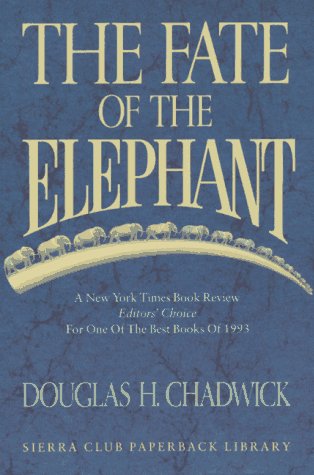
Fate of the Elephant
Regular price
$8.95 USD
Regular price
Sale price
$8.95 USD
Unit price
per
Shipping calculated at checkout.
Couldn't load pickup availability
Title: Fate of the Elephant
Author: Douglas H Chadwick
ISBN: 0871564955
Publisher: Sierra Club Books
Published: 1994
Binding: Paperback
Language: English
Number of Pages: 492
Condition Note: Moderate edge wear. Binding good. May have marking in text. We sometimes source from libraries. We ship in recyclable American-made mailers. 100% money-back guarantee on all orders.
Publisher Description: With a single hand, he can pull two palm trees to the ground. If he had two hands, he could tear the sky...So unfolds a Yoruba poem celebrating the largest, most powerful, and one of the smartest creatures to walk the planet: the elephant. In this richly detailed exploration of the natural history and troubled fate of both the African and Asian species of elephant, noted wildlife biologist and author Douglas Chadwick travels the world to acquaint us with these awesome giants. Through visits to India, Siberia, Botswana, Thailand, Malaysia, Kenya, and even an American zoo, Chadwick illustrates the pivotal role the elephant plays in shaping and balancing not only the ecosystems it calls home, but also the livelihoods of a wide array of people. We travel to East Africa and join elephant families on the savannas of Amboseli Reserve in the shadow of Kilimanjaro. In the thick jungles of the Congo Basin, Chadwick leads us down pygmy footpaths on the trail of the elusive forest elephant. In Asia we experience a day in the life of a working elephant at an Indian timber camp, and take a raft trip to transplant problem elephants to remote areas of the Malaysian rainforest. At the zoo, we watch a four-ton artist take brush in trunk and paint a canvas with delicate strokes. In each place we visit, Chadwick reveals the elephant as a playful, intelligent being, full of surprises and ready to smash the narrow confines from which we traditionally view animals. As he shows us how similar elephants are to humans - they travel in closely knit families, learn from each other, look after their ill and elderly, mourn their dead, and communicate through a vocabulary of audible and subsonic sounds that add up toa surprisingly nuanced and expressive language - he leads us to rethink our definition of and approach to conservation.
Author: Douglas H Chadwick
ISBN: 0871564955
Publisher: Sierra Club Books
Published: 1994
Binding: Paperback
Language: English
Number of Pages: 492
Condition Note: Moderate edge wear. Binding good. May have marking in text. We sometimes source from libraries. We ship in recyclable American-made mailers. 100% money-back guarantee on all orders.
Publisher Description: With a single hand, he can pull two palm trees to the ground. If he had two hands, he could tear the sky...So unfolds a Yoruba poem celebrating the largest, most powerful, and one of the smartest creatures to walk the planet: the elephant. In this richly detailed exploration of the natural history and troubled fate of both the African and Asian species of elephant, noted wildlife biologist and author Douglas Chadwick travels the world to acquaint us with these awesome giants. Through visits to India, Siberia, Botswana, Thailand, Malaysia, Kenya, and even an American zoo, Chadwick illustrates the pivotal role the elephant plays in shaping and balancing not only the ecosystems it calls home, but also the livelihoods of a wide array of people. We travel to East Africa and join elephant families on the savannas of Amboseli Reserve in the shadow of Kilimanjaro. In the thick jungles of the Congo Basin, Chadwick leads us down pygmy footpaths on the trail of the elusive forest elephant. In Asia we experience a day in the life of a working elephant at an Indian timber camp, and take a raft trip to transplant problem elephants to remote areas of the Malaysian rainforest. At the zoo, we watch a four-ton artist take brush in trunk and paint a canvas with delicate strokes. In each place we visit, Chadwick reveals the elephant as a playful, intelligent being, full of surprises and ready to smash the narrow confines from which we traditionally view animals. As he shows us how similar elephants are to humans - they travel in closely knit families, learn from each other, look after their ill and elderly, mourn their dead, and communicate through a vocabulary of audible and subsonic sounds that add up toa surprisingly nuanced and expressive language - he leads us to rethink our definition of and approach to conservation.