Cambridge University Press
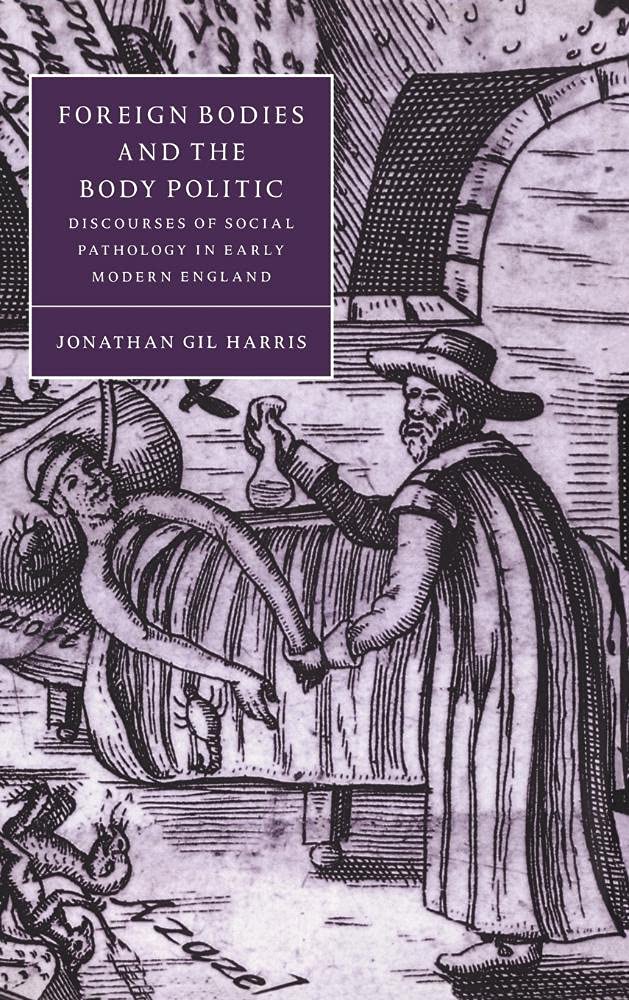
Foreign Bodies and the Body Politic: Discourses of Social Pathology in Early Modern England
Regular price
$40.95 USD
Regular price
Sale price
$40.95 USD
Unit price
per
Shipping calculated at checkout.
Couldn't load pickup availability
Title: Foreign Bodies and the Body Politic: Discourses of Social Pathology in Early Modern England
Author: Jonathan Gil Harris
ISBN: 9780521594059
Publisher: Cambridge University Press
Published: 1998
Binding: Hardcover
Language: English
Number of Pages: 216
Condition Note: Excellent, unmarked copy with little wear and tight binding. We ship in recyclable American-made mailers. 100% money-back guarantee on all orders.
Publisher Description: This book examines the overlap between early modern English attitudes to disease and to society and explores the cultural meaning of the image of the body at the interfaces of medicine, morality and politics in Tudor and early Stuart England. In particular, it demonstrates how the body politic's metaphorical "cankers" and "plagues" were increasingly attributed to allegedly pathological "foreign bodies" such as Jews, Catholics, and witches. One can glimpse the origins of not only modern xenophobic attitudes to foreigners as carriers of disease, but also "germ" theory in general. The pathological and the political thus have a long-standing, problematic, and mostly neglected relationship, the prehistory of which this book seeks to uncover.
Author: Jonathan Gil Harris
ISBN: 9780521594059
Publisher: Cambridge University Press
Published: 1998
Binding: Hardcover
Language: English
Number of Pages: 216
Condition Note: Excellent, unmarked copy with little wear and tight binding. We ship in recyclable American-made mailers. 100% money-back guarantee on all orders.
Publisher Description: This book examines the overlap between early modern English attitudes to disease and to society and explores the cultural meaning of the image of the body at the interfaces of medicine, morality and politics in Tudor and early Stuart England. In particular, it demonstrates how the body politic's metaphorical "cankers" and "plagues" were increasingly attributed to allegedly pathological "foreign bodies" such as Jews, Catholics, and witches. One can glimpse the origins of not only modern xenophobic attitudes to foreigners as carriers of disease, but also "germ" theory in general. The pathological and the political thus have a long-standing, problematic, and mostly neglected relationship, the prehistory of which this book seeks to uncover.