Oxford University Press
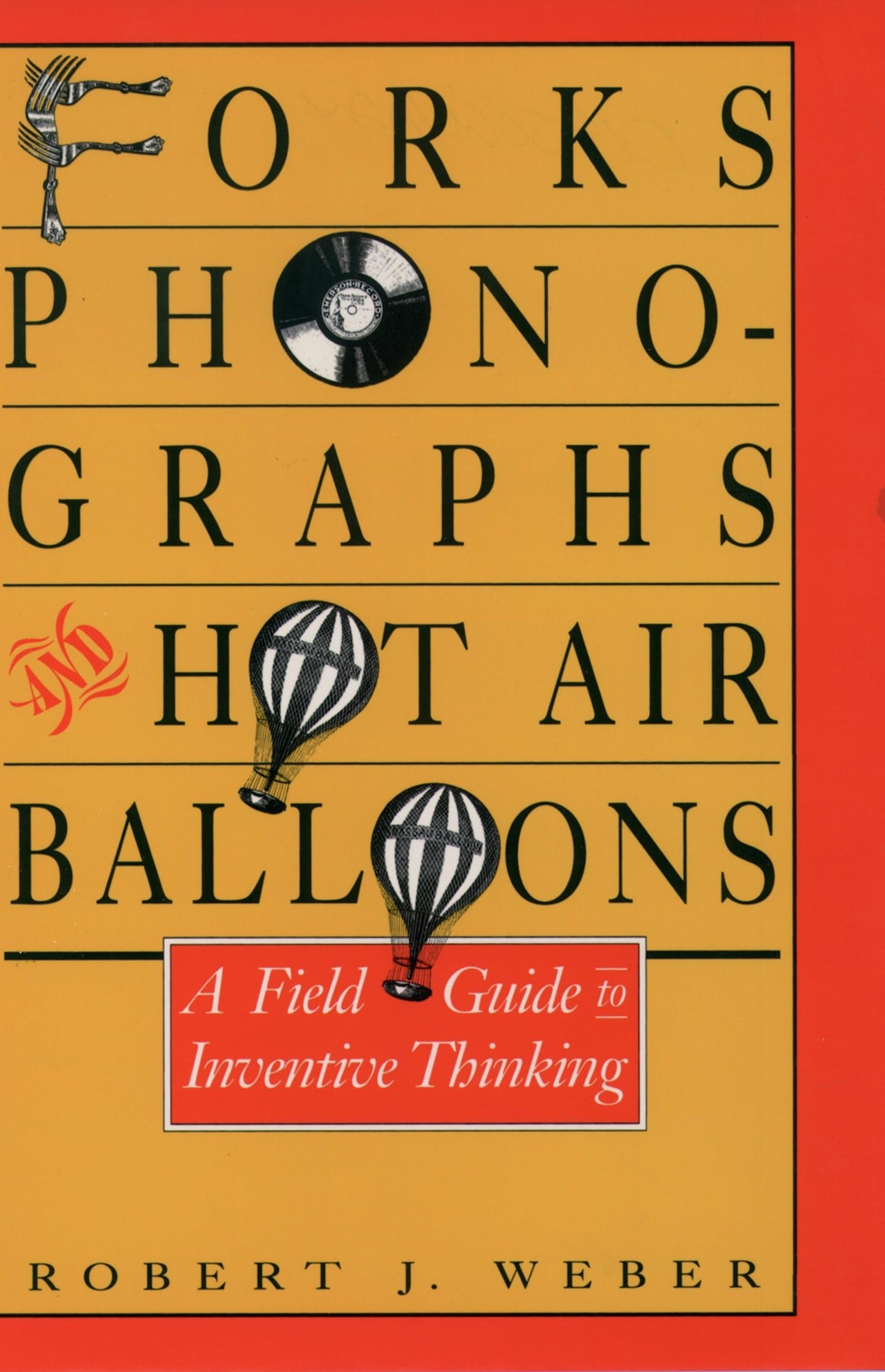
Forks, Phonographs, and Hot Air Balloons: A Field Guide to Inventive Thinking
Regular price
$11.95 USD
Regular price
Sale price
$11.95 USD
Unit price
per
Shipping calculated at checkout.
Couldn't load pickup availability
Title: Forks, Phonographs, and Hot Air Balloons: A Field Guide to Inventive Thinking
Author: Robert J Weber
ISBN: 9780195064025
Publisher: Oxford University Press
Published: 1993
Binding: Hardcover
Language: English
Number of Pages: 296
Condition Note: Clean, unmarked copy with some edge wear. Good binding. Dust jacket included if issued with one. We ship in recyclable American-made mailers. 100% money-back guarantee on all orders.
Publisher Description: How do inventions take shape? How did the inventors of the sewing needle, the hammer, or the wheel find their ideas? Are these creations the result of random events, or are hidden principles at work? Using everyday objects most of us take for granted - from forks and Velcro to safety pins and doorknobs - noted cognitive psychologist Robert Weber takes a fascinating look at how our world of inventions came into being, and how the mind's problem-solving abilities gave them the forms they have. As an archeologist studies shards of pottery for clues about an ancient culture, Weber examines the many forms of inventions, from stone knives to genetically engineered mice, and finds a rich record of the work of many minds over time - a record of human creativity and problem-solving handed down through the centuries. He offers various methods for analyzing what mental paths might have been taken by these inventive minds. In the test for design, for example, he ponders how an item would work if various components were shuffled or constructed differently, revealing how the optimal shape of the invention was discovered. He challenges the reader to engage in thought experiments to explore how the horse-drawn cart, the waterscrew, or the fork might have taken shape over many years, through the efforts of successive inventors and adaptors. In stripping these simple artifacts to the bone, Weber finds a hidden intelligence at work in everyday objects as well as recurrent heuristics (basic principles or rules of thumb) that are common among many of our most successful inventions - heuristics powerful enough to generate endless new ideas. Weber ranges across the work of Archimedes, Leonardo da Vinci, theWright brothers, as well as grade-school children who have won national awards for their inventions, revealing that the same principles are at work in the discoveries of all of them. Basic principles of invention, he writes, govern how we think, solve, and manipulate ideas, whethe
Author: Robert J Weber
ISBN: 9780195064025
Publisher: Oxford University Press
Published: 1993
Binding: Hardcover
Language: English
Number of Pages: 296
Condition Note: Clean, unmarked copy with some edge wear. Good binding. Dust jacket included if issued with one. We ship in recyclable American-made mailers. 100% money-back guarantee on all orders.
Publisher Description: How do inventions take shape? How did the inventors of the sewing needle, the hammer, or the wheel find their ideas? Are these creations the result of random events, or are hidden principles at work? Using everyday objects most of us take for granted - from forks and Velcro to safety pins and doorknobs - noted cognitive psychologist Robert Weber takes a fascinating look at how our world of inventions came into being, and how the mind's problem-solving abilities gave them the forms they have. As an archeologist studies shards of pottery for clues about an ancient culture, Weber examines the many forms of inventions, from stone knives to genetically engineered mice, and finds a rich record of the work of many minds over time - a record of human creativity and problem-solving handed down through the centuries. He offers various methods for analyzing what mental paths might have been taken by these inventive minds. In the test for design, for example, he ponders how an item would work if various components were shuffled or constructed differently, revealing how the optimal shape of the invention was discovered. He challenges the reader to engage in thought experiments to explore how the horse-drawn cart, the waterscrew, or the fork might have taken shape over many years, through the efforts of successive inventors and adaptors. In stripping these simple artifacts to the bone, Weber finds a hidden intelligence at work in everyday objects as well as recurrent heuristics (basic principles or rules of thumb) that are common among many of our most successful inventions - heuristics powerful enough to generate endless new ideas. Weber ranges across the work of Archimedes, Leonardo da Vinci, theWright brothers, as well as grade-school children who have won national awards for their inventions, revealing that the same principles are at work in the discoveries of all of them. Basic principles of invention, he writes, govern how we think, solve, and manipulate ideas, whethe