Continuum
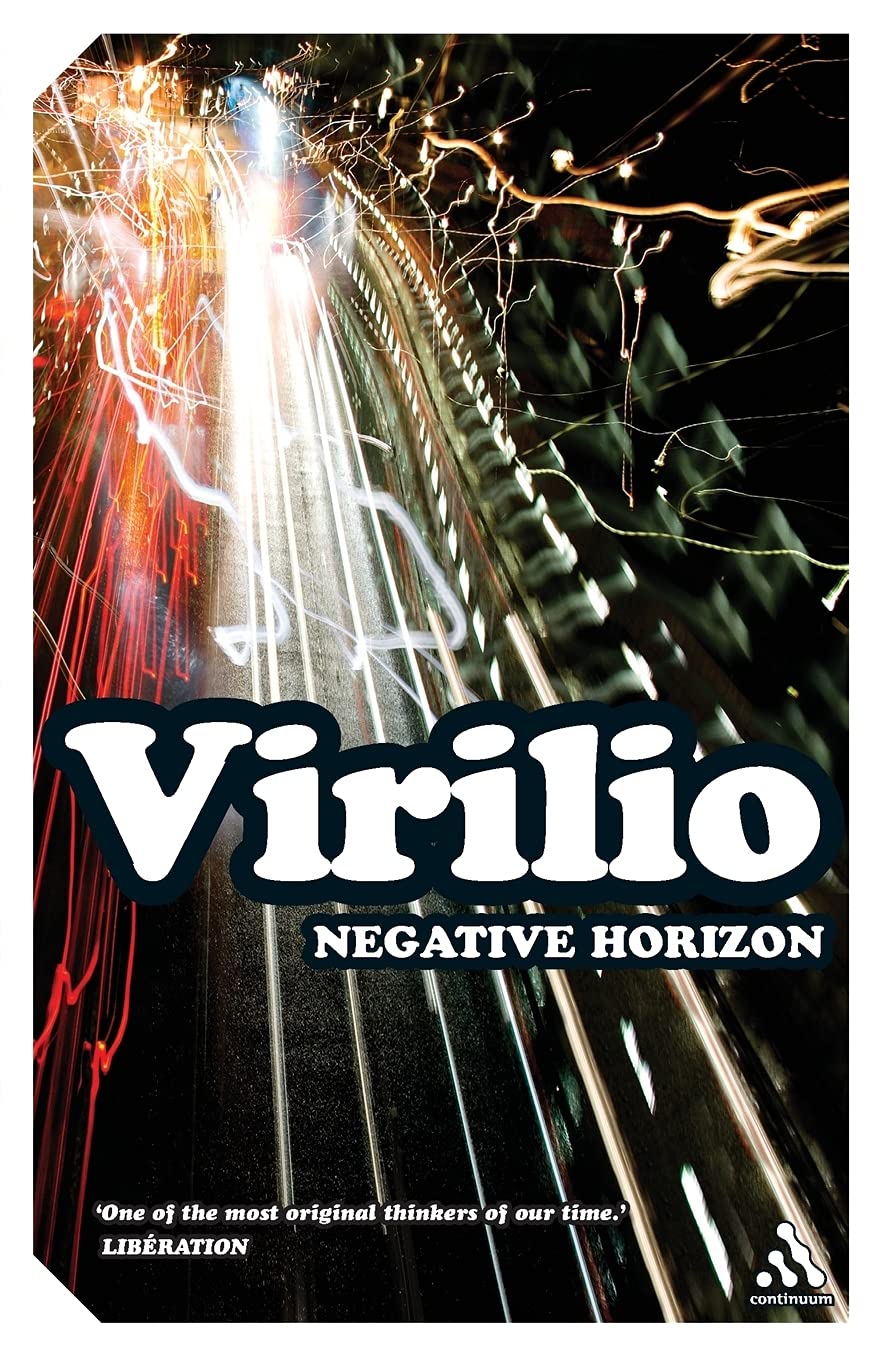
Negative Horizon: An Essay in Dromoscopy
Regular price
$10.95 USD
Regular price
Sale price
$10.95 USD
Unit price
per
Shipping calculated at checkout.
Couldn't load pickup availability
Title: Negative Horizon: An Essay in Dromoscopy
Author: Paul Virilio
ISBN: 9781847063069
Publisher: Continuum
Published: 2008
Binding: Paperback
Language: English
Edition: 1
Number of Pages: 224
Condition Note: Moderate edge wear. Binding good. May have marking in text. We sometimes source from libraries. We ship in recyclable American-made mailers. 100% money-back guarantee on all orders.
Publisher Description: Negative Horizon is Paul Virilio's most original and unified exploration of the key themes and ideas running through his philosophy. Provocative and forceful, it sets out Virilio's theory of dromoscopy: a means of apprehending speed and its pivotal - and potentially destructive - role in contemporary global society. Applying this theory to Western political and military history, Virilio exposes a compulsion to accelerate, and the rise of a politics of time over territorial politics of space. In exposing what he believes to be the consequences of this constant acceleration for human sensory perception and, ultimately, global democracy, Virilio offers a vision of history and politics as disturbing as it is original.
Author: Paul Virilio
ISBN: 9781847063069
Publisher: Continuum
Published: 2008
Binding: Paperback
Language: English
Edition: 1
Number of Pages: 224
Condition Note: Moderate edge wear. Binding good. May have marking in text. We sometimes source from libraries. We ship in recyclable American-made mailers. 100% money-back guarantee on all orders.
Publisher Description: Negative Horizon is Paul Virilio's most original and unified exploration of the key themes and ideas running through his philosophy. Provocative and forceful, it sets out Virilio's theory of dromoscopy: a means of apprehending speed and its pivotal - and potentially destructive - role in contemporary global society. Applying this theory to Western political and military history, Virilio exposes a compulsion to accelerate, and the rise of a politics of time over territorial politics of space. In exposing what he believes to be the consequences of this constant acceleration for human sensory perception and, ultimately, global democracy, Virilio offers a vision of history and politics as disturbing as it is original.