Yale University Press
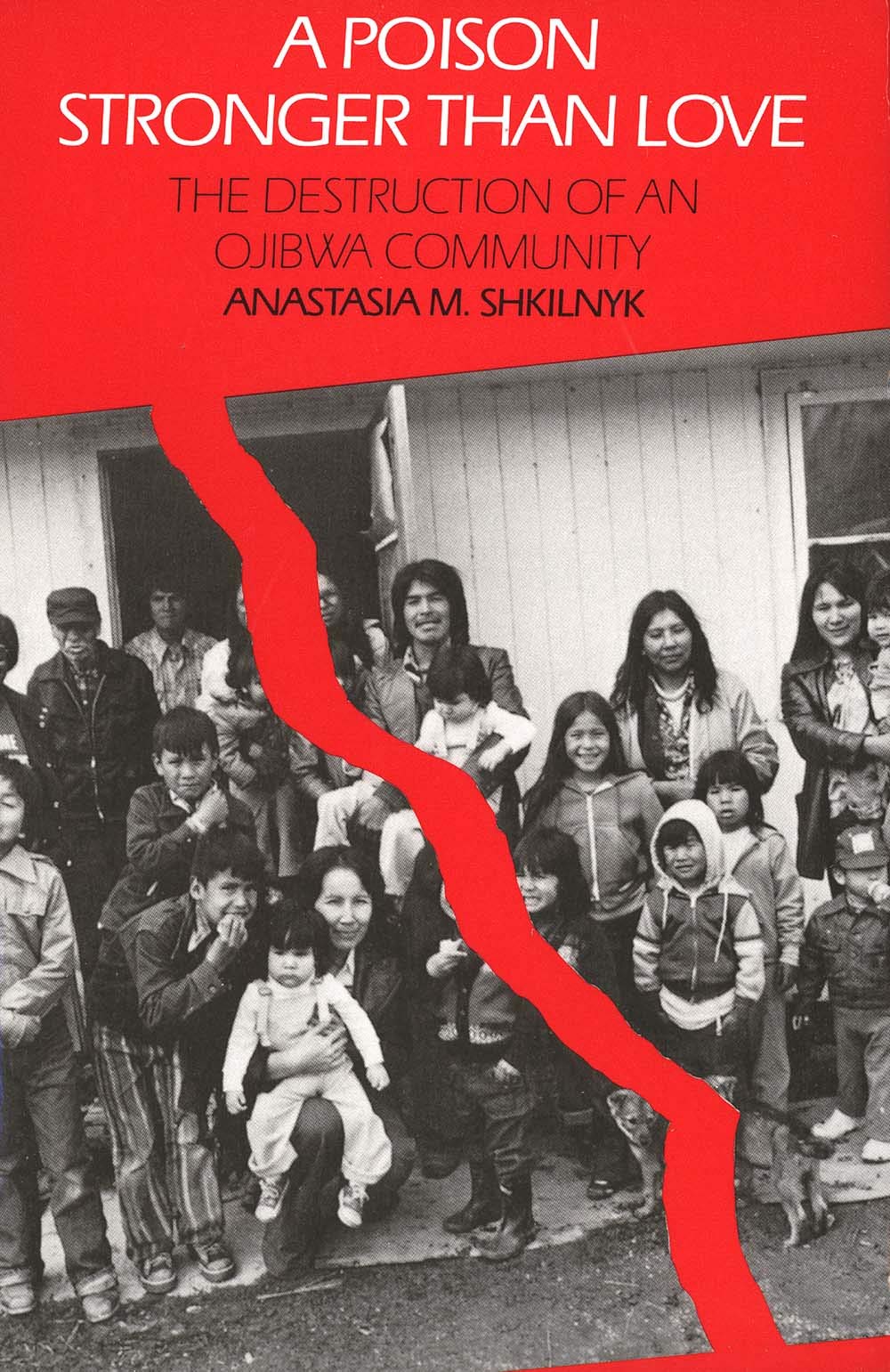
Poison Stronger Than Love: The Destruction of an Ojibwa Community
Regular price
$12.95 USD
Regular price
Sale price
$12.95 USD
Unit price
per
Shipping calculated at checkout.
Couldn't load pickup availability
Title: Poison Stronger Than Love: The Destruction of an Ojibwa Community
Author: Anastasia Shkilnyk
ISBN: 0300033257
Publisher: Yale University Press
Published: 1985
Binding: Paperback
Language: English
Number of Pages: 276
Condition Note: Clean, unmarked copy with some edge wear. Good binding. Dust jacket included if issued with one. We ship in recyclable American-made mailers. 100% money-back guarantee on all orders.
Publisher Description: "I can't explain it to you, because I can't explain it to myself. The only thing I know is that alcohol is a stronger power than the love of children. It's a poison, and we are a broken people. We suffer enough inside, and therefore we understand each other."--Resident of Grassy Narrows "A work of luminous compassion and rigorous analysis. . . . Should be required reading . . . for anyone interested in the bonds of community that make people human." --M.T. Kelly, Toronto Globe and Mail Grassy Narrows is a small Ojibwa village in northwestern Ontario, Canada. It first captured national attention in 1970, when mercury pollution was discovered in the adjacent English-Wabigoon River. In the course of the assessment of environmental damage, an even more compelling tragedy came to light. For in little more than a decade, the Indian people had begun to self-destruct. This powerful book documents the human costs of massive and extraordinarily rapid change in a people's way of life. When well-intentioned bureaucrats relocated the Grassy Narrows band to a new reserve in 1963, the results were the unraveling of the tribe's social fabric and a sharp deterioration in their personal morale - dramatically reflected in Shkilnyk's statistics on violent death, illness, and family breakdown. The book explores the origins and causes of the suffering in the community life and describes the devastating impacts of mercury contamination on the health and livelihood of the Indian people. In essence, this is an in-depth and comprehensive study of the forces and pressures that can rend a community apart. As such it is of interest not only to those particularly concerned with the fate of aboriginal peoples on the continent but also to those more broadly concerned with human collective response to unprecedented stress.