UNKNO
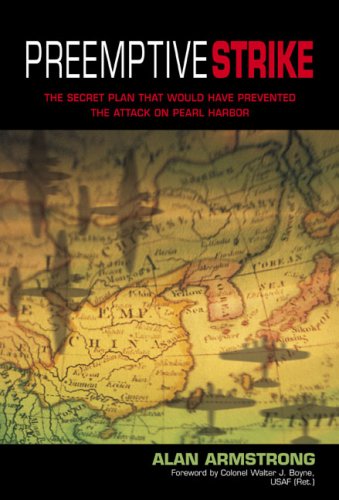
Preemptive Strike: The Secret Plan That Would Have Prevented the Attack on Pearl Harbor
Regular price
$9.95 USD
Regular price
Sale price
$9.95 USD
Unit price
per
Shipping calculated at checkout.
Couldn't load pickup availability
Title: Preemptive Strike: The Secret Plan That Would Have Prevented the Attack on Pearl Harbor
Author: Alan Armstrong
ISBN: 9781592289134
Publisher: UNKNO
Published: 2006
Binding: Hardcover
Language: English
Edition: First Edition
Number of Pages: 285
Condition Note: Excellent, unmarked copy with little wear and tight binding. We ship in recyclable American-made mailers. 100% money-back guarantee on all orders.
Publisher Description: The untold story of a secret planthat would have prevented Pearl Harbor--and maybe even World War II.
Could a plan to bomb Japan and destroy Japanese supply lines, communications, and staging areas in China have averted the horrendous and devastating attack on Pearl Harbor? On July 23, 1941--some five months before Pearl Harbor--President Franklin Delano Roosevelt endorsed a plan calling for the United States to provide China with 150 manned bombers and 350 fighter planes to wreak havoc on Japan's growing presence in China. "Joint Board Plan 335" had been proposed to Roosevelt and his cabinet by Generalissimo Chiang Kai-shek; Dr. T. V. Soong, China's special envoy to the United States; and Captain Claire Lee Chennault, a retired Air Corps pilot now in the employ of Chiang. Such a preemptive strike on Japanese interests had been under discussion for several months. Although initially blocked by General George C. Marshall, the plan was resurrected in the spring of 1941. So why, then, was it never employed?
First, there were the practical reasons: Not yet fully recovered from the Great Depression, millions of Americans were more concerned about domestic issues than foreign policy. Roosevelt and his cabinet feared political fallout from Chiang's proposed international intrigue, to say nothing of facing Winston Churchill's wrath by diverting airplanes from Britain. Then there were also ethical concerns over the definite civilian casualties the air strike would inflict. Could Roosevelt justify bombing raids when the U.S. and Japan were officially at peace? Chiang and Chennault argued that their plan would serve as a moral quid pro quo to an adversary that had been bombing and slaughtering millions of Chinese civilians for three years. The raids, Chennault insisted, would forestall Japanese expansion into Malaya, Singapore, the Dutch East Indies, and the Philippines.
Painstakingly researched and colorfully written, Preemptive Strike offers a seldom-seen glimpse of the political and moral pressures brought to bear on Roosevelt's prewar cabinet. It is sure to prompt debate, as much as the decision to use this wartime strategy does today.
Author: Alan Armstrong
ISBN: 9781592289134
Publisher: UNKNO
Published: 2006
Binding: Hardcover
Language: English
Edition: First Edition
Number of Pages: 285
Condition Note: Excellent, unmarked copy with little wear and tight binding. We ship in recyclable American-made mailers. 100% money-back guarantee on all orders.
Publisher Description: The untold story of a secret planthat would have prevented Pearl Harbor--and maybe even World War II.
Could a plan to bomb Japan and destroy Japanese supply lines, communications, and staging areas in China have averted the horrendous and devastating attack on Pearl Harbor? On July 23, 1941--some five months before Pearl Harbor--President Franklin Delano Roosevelt endorsed a plan calling for the United States to provide China with 150 manned bombers and 350 fighter planes to wreak havoc on Japan's growing presence in China. "Joint Board Plan 335" had been proposed to Roosevelt and his cabinet by Generalissimo Chiang Kai-shek; Dr. T. V. Soong, China's special envoy to the United States; and Captain Claire Lee Chennault, a retired Air Corps pilot now in the employ of Chiang. Such a preemptive strike on Japanese interests had been under discussion for several months. Although initially blocked by General George C. Marshall, the plan was resurrected in the spring of 1941. So why, then, was it never employed?
First, there were the practical reasons: Not yet fully recovered from the Great Depression, millions of Americans were more concerned about domestic issues than foreign policy. Roosevelt and his cabinet feared political fallout from Chiang's proposed international intrigue, to say nothing of facing Winston Churchill's wrath by diverting airplanes from Britain. Then there were also ethical concerns over the definite civilian casualties the air strike would inflict. Could Roosevelt justify bombing raids when the U.S. and Japan were officially at peace? Chiang and Chennault argued that their plan would serve as a moral quid pro quo to an adversary that had been bombing and slaughtering millions of Chinese civilians for three years. The raids, Chennault insisted, would forestall Japanese expansion into Malaya, Singapore, the Dutch East Indies, and the Philippines.
Painstakingly researched and colorfully written, Preemptive Strike offers a seldom-seen glimpse of the political and moral pressures brought to bear on Roosevelt's prewar cabinet. It is sure to prompt debate, as much as the decision to use this wartime strategy does today.